
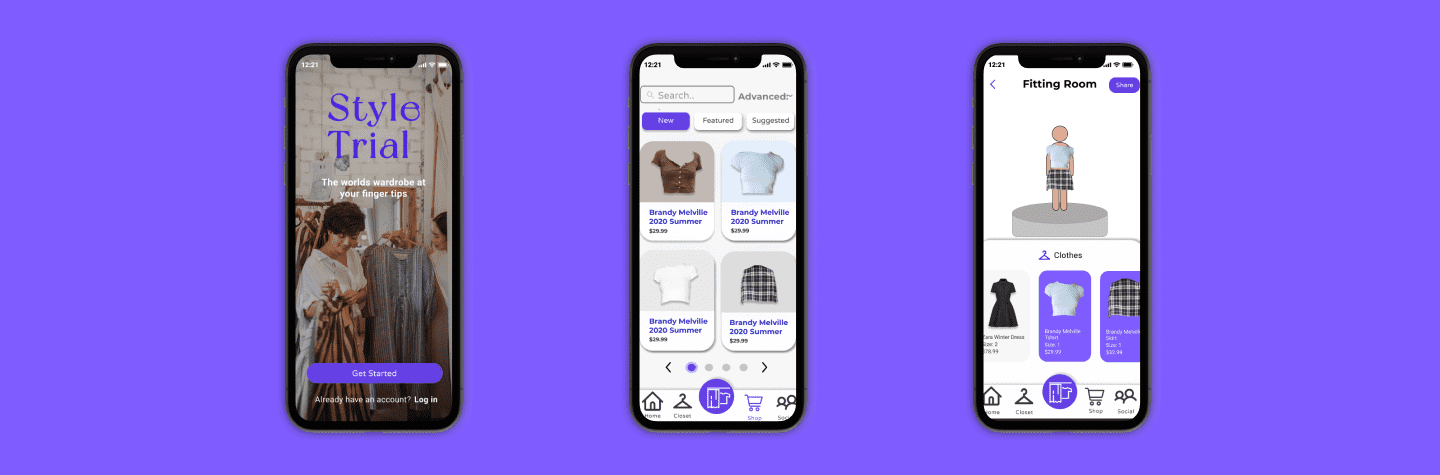
Style Trial
timeline
3 Months
team
Lukas Stein
Vicky Pei Jou Liu
Yani Shi
tools
Figma
role
User Research, Design and Prototyping
Brief
As part of the semester project for theDesign for User Expereince course at USC, I had the opportunity to work on StyleTrial alongside Vicky Pei Jou Liu, Yani Shi, and Lukas Stein. We took on the challenge of building StyleTrial, a mobile app that will revolutionize the way we approach online shopping. For this project we employed an iterative process where we actively collect data from our potential users in order to improve our product.
User Research Round 1
For our initial research session we had the opportunity to interview 5 stakeholders in order to validate different problems we identified for the online shopping industry. Data from this round of research indicated that60% of our stakeholders expressed an interest in an application that provides users with a virtual dressing room and a customizable avatar. A key takeaway from one of our stakeholders is:
Defining the Problem
After analyzing the data from our first round of research, we constructed the following problem statement:
User Research Round 2
Our next goal was to get a better understanding of online shopping habits. Therefore, we conducted further research with 6 different stakeholders by asking them a set of 7 questions. This research allowed us to get an idea of how people think and feel about online shopping. The data reaffirmed that problem we identified is real and that it acts as a deterrent to online shopping. Furthermore, we also utilized this data to start constructing the personas that would engage with the app and the features that address our problem statement.
- Research Data -
Visual Value Proposition - First Iteration
For our Visual Value Proposition we wanted to make sure that effectively conveyed that StyleTrial would enable users to enter virtual fitting room in order try out any clothes they want. We choose a combination of a catch phrase a picture of full closet. We would soon find out this was not the most effective way of communicating our intent.


Primary User
We indentfied Valarie Chen as our primary user. Valarie main motivator to engage with StyleTrial is her great sense of fashion and her desire to stay up to date with the latest styles. Valarie utilizes StyleTrial create hundreds of outfit combinations without having to leave the safety of her home. Valarie would serve the main persona would guide the design and functionality of the product.


Scenario
Storyboard
Our goal was to visually demonstrate what it would like for people to utilize StyleTrial. This helped organize our thoughts as to how the features would be used and what is in order. Although our app logic changed in the later stages of development, the storyboard helped create a good foundation to start from.


Low Fidelity Wireframes
The next step was to start building out the initial wireframes. We tried not to spend too much time on color and the assets. Instead focused on how the user would navigate through the app. Throughout the process we kept referring back to our storyboard and scenario to make sure we were on the right track.


Visual value propositon Final Iteration
We went for a more refined look. Instead of an image of a boring closet. We opted to create an interactive slider that would cycle different articles of clothing. As a new item is selected and the model is updated to reflect that item. Not does it convey that users will have access to different clothes in the app but also it highlights the ability to try those items on.
Design System
Before we could start on the Minimal Viable Product, we needed to create a Design System. This would ensure that every team member will consistent designs even if they work on different features of the app. Doing this upfront helped us save time because we no longer had to spend deciding on things colors, icons and typography while designing.
High Fidelity Designs
This is where the team really came together. After three round of user research we were ready to start implementing the insights we have gained into high fidelity designs. In order to make the design process more manageable, we decided to split work based on the features/functionality that Style Trial would have. This way we could all work in parallel and get more done in a small amount of time. After each team member finalized their designs, we came together to start connecting all the frames.


Our Solution
After weeks of research and design, we finally have our solution.Style Trial is mobile app that will revolutionize the way people approach online shopping.With Style Trial you no longer have to second guess yourself when it comes to deciding where a piece of clothing will fit or not. Instead fire up Style Trial, modify your avatar, and try on outfits to your heart's content.
Pitch Deck
Part of the semester project includes doing a 7 minute presentation of our product. In our pitch deck we opted to highlight our primary user and story. With every feature we illustrate what it looks like when a user like Valarie, engages with Style Trial.
Reflection
I definitely learned a lot during this process and it was one of the best experiences I've had with a group project. I had great teammates that where very responsive and at the top of their game. At every stage of of the design process, we made sure to utilize each other's strength. The biggest lesson I learned, was how to manage short deadlines especially when the workload is intense. Communication amongst your team is key to getting done on time and with high quality. Normally i'm more of a quiet person who would give little input and feedback. However, in this project, in this project I challenged myself to be more involved to share my ideas.